
In competitions of the Turkish Mountaineering Federation (TDF), calculation procedures vary across the three disciplines and between competition formats. Below, these procedures are explained discipline by discipline: Lead, Boulder and Speed. The examples follow the TDF national rulebook; World Climbing’s international scoring is summarised on our Routes and Grading page.
In addition, there are separate calculation procedures for school sports competitions and for Ünilig competitions held by the Turkish University Sports Federation.
- School sports scoring
- Ünilig scoring
IMPORTANT: please base your own calculations on the TDF national rulebook.
Lead scoring
Procedure used in national competitions
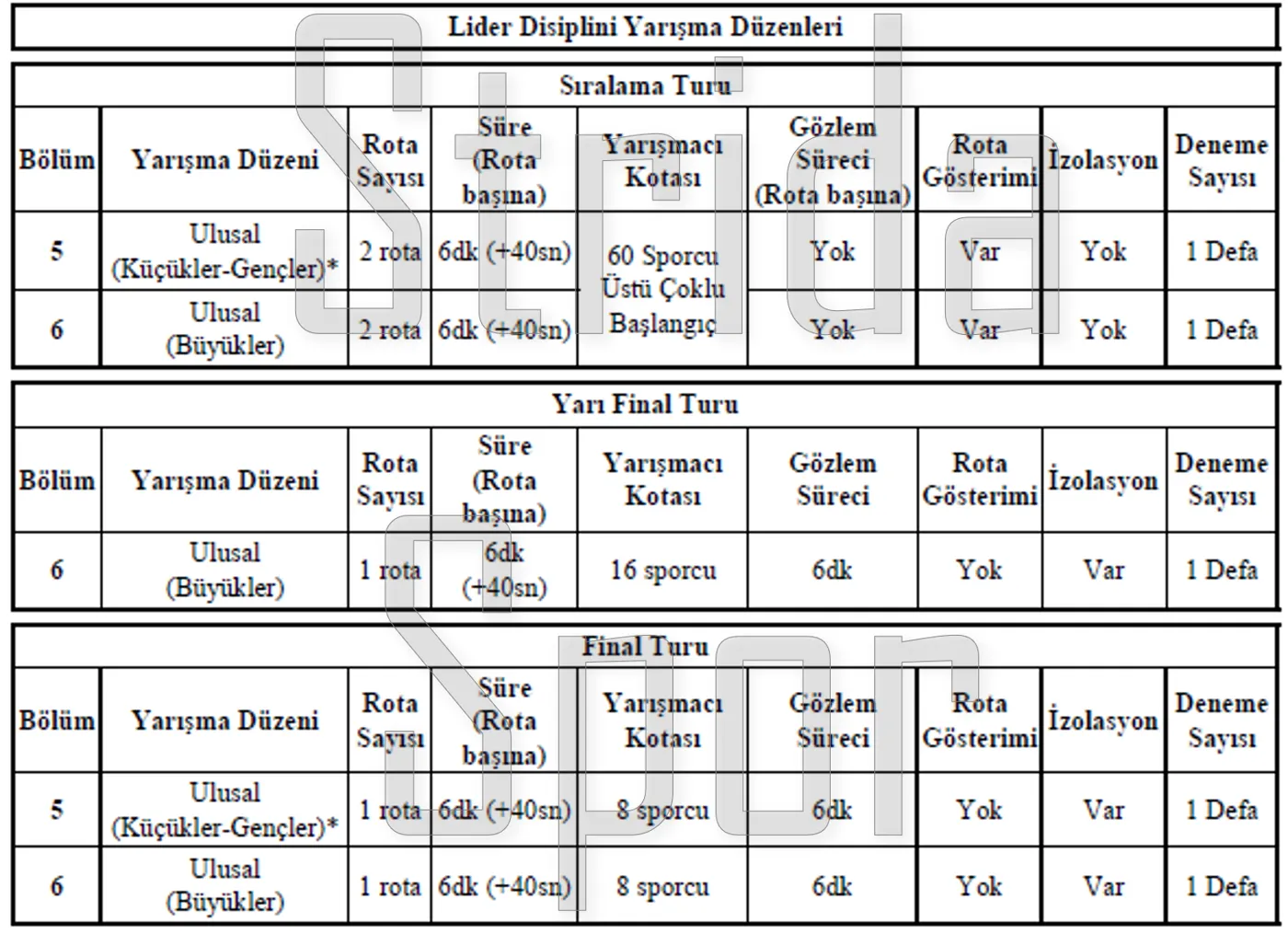
The national competition formats used in Lead (excluding the combined format) are shown in the image above. The calculation procedures used in these formats differ between the qualification round and the later rounds.
Calculating the qualification total score
Once the results are entered, the first step is to calculate the Route 1 and Route 2 scores used for the qualification total score. The following steps are carried out in order for each route.
- The route results are filled in for each athlete.
- If there are no ties, each athlete’s score for that route is the same as their place after ranking. If there are ties, continue with the procedure below.
- To make the calculation mathematical, athletes who TOP are given 250 points and other athletes are given the number of holds they reached as points. Athletes with a “+” (a move made) get an extra 0.5 points, giving the route score (Route A score).
- The athletes’ qualification A rank values are then determined from the Route A scores.
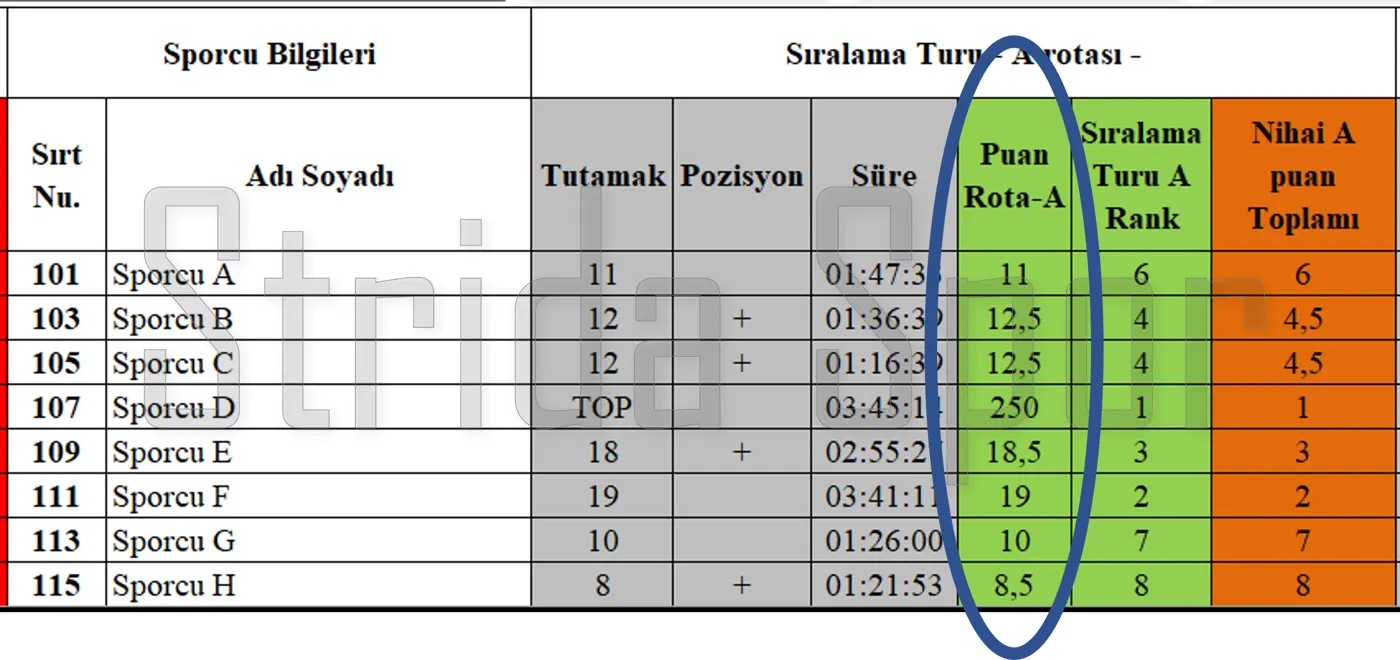
Important note: to avoid confusion, it helps to briefly explain the RANK function in Microsoft Excel.
The RANK function in Microsoft Excel returns the position of a number when you sort a list. It gives the same rank to equal numbers, but equal numbers affect the ranks of the numbers that follow. In the example above: if the number 12.5 appears twice in our Route A score list and would take ranks 4 and 5, the rank of 11 will be 6 (no number will have rank 5).
- The athletes’ qualification A rank values are then determined from the Route A scores. (As the sample calculation above shows, athletes B and C, who scored 12+, both get a qualification A rank of 4, but rank 5 is skipped across the list and the next athlete, A with 11 points, gets a rank of 6.)
- The final A scores are then set from the qualification A rank values. At this stage, the following applies to tied athletes. (In our example, if athletes B and C were not tied, their ranks would be 4 and 5. Because they are tied, we add these ranks and divide by the number of tied athletes: (4+5)/2 = 4.5 is their final A score.)
- Following the example in the rulebook, if we had six athletes tied for first, their rank would be 1 and their final score (1+2+3+4+5+6)/6 = 3.5.
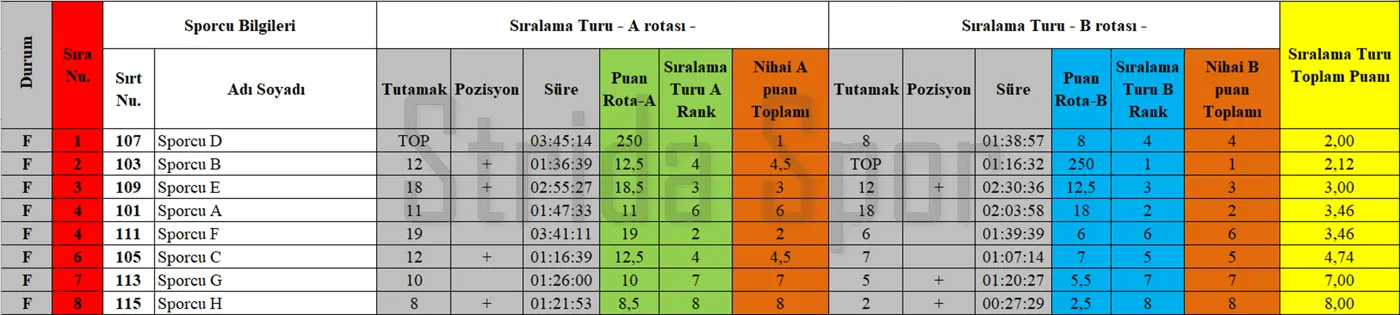
- Once these steps are done for both routes, the qualification total score (QTS) is calculated as QTS = √(Route A score × Route B score).
Using our example:
- For athlete D: QTS = √(1 × 4) → QTS = √4 → QTS = 2.
- For athlete A: QTS = √(6 × 2) → QTS = √12 → QTS = 3.46.
Semi-final and final rankings
- In the semi-final and final, athletes are ranked by their top, hold, move and time in that round. The only exception is when there is a tie in the round, in which case the count-back procedure in the national rulebook is applied.
- As the example below shows, athletes D and F have equal holds and moves in the final, so after count-back D is 2nd and F is 3rd. The same applies to athletes B, E and A.
(NOTE: time does not change the ranking where there is no tie and count-back does not apply.)
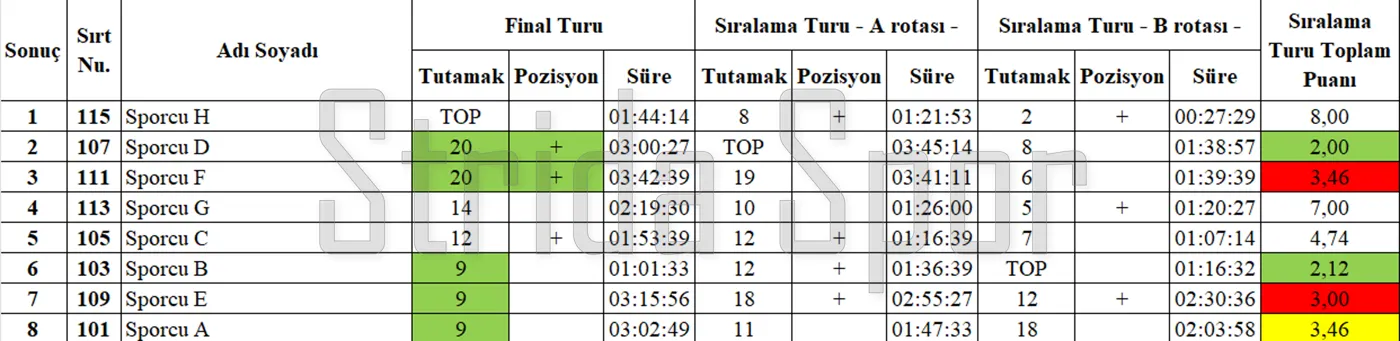
After all rounds and procedures are complete and checked by the Central Judges Board, a results table including the competition points below is published on the TDF website.
(To avoid any misunderstanding, one point is worth explaining. The TDF sets the criteria for calling athletes to national team camps each year. Under the 2026 criteria, athletes who reach the podium at the Turkish Cup in each discipline are called to the national team candidate camp. In Speed, athletes who run under 10 seconds (women) or 6.50 seconds (men) in any round are also called. In 2024 only points from the Turkish Championships counted. You can find the 2026 criteria here (in Turkish). We recommend using federation data for your own work.)
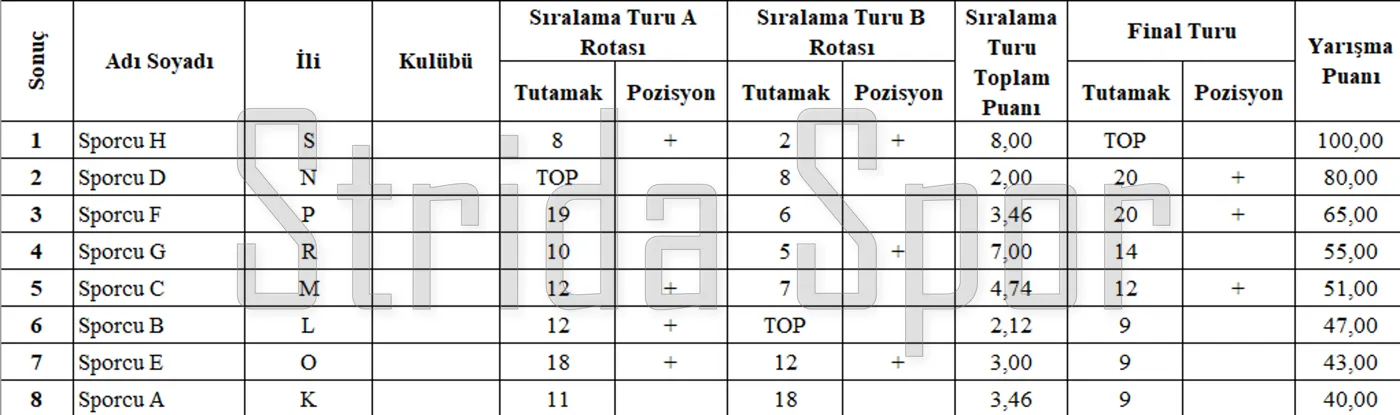
Procedure used in the combined (B&L) format
Boulder scoring
Procedure used in the World Climbing format
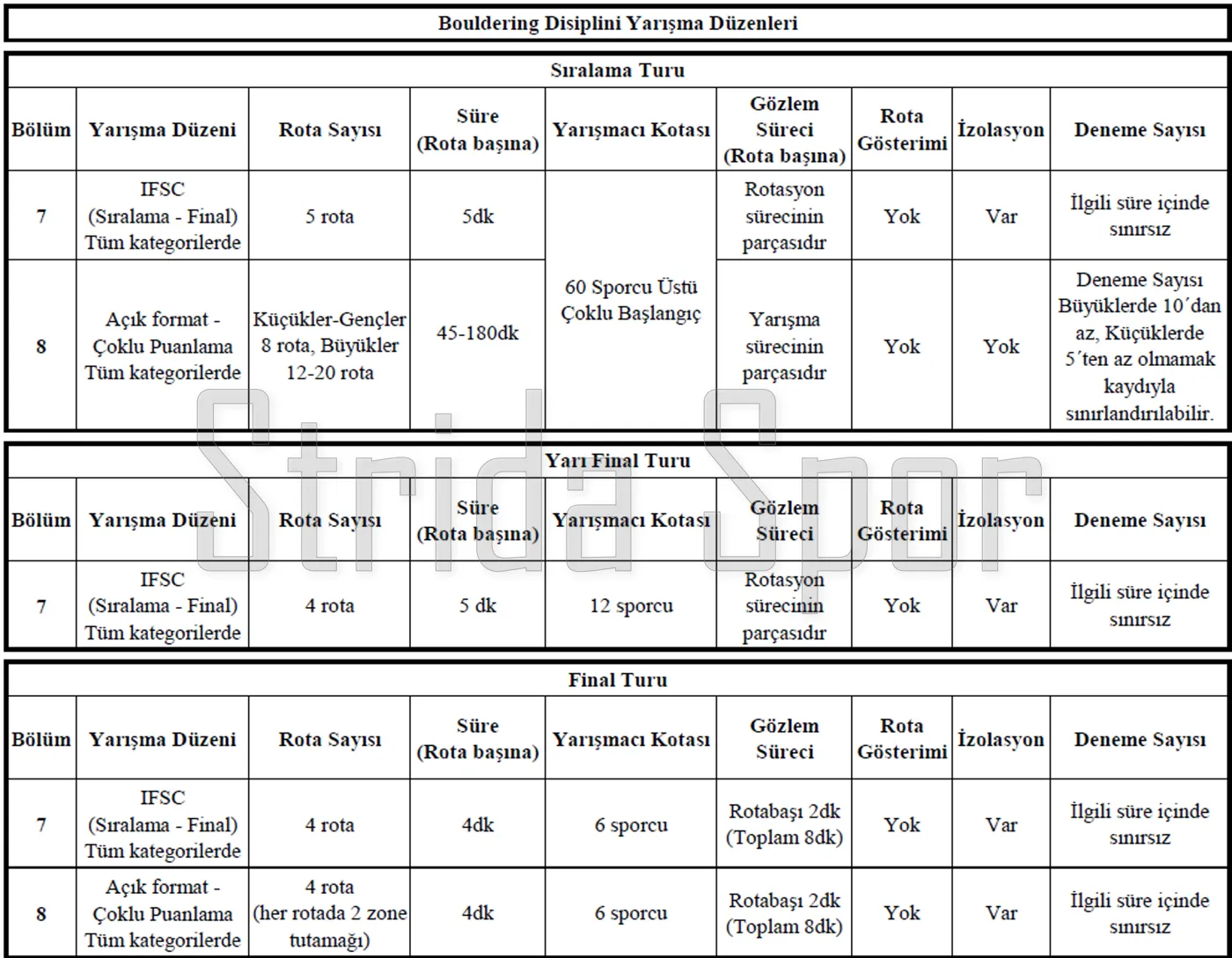
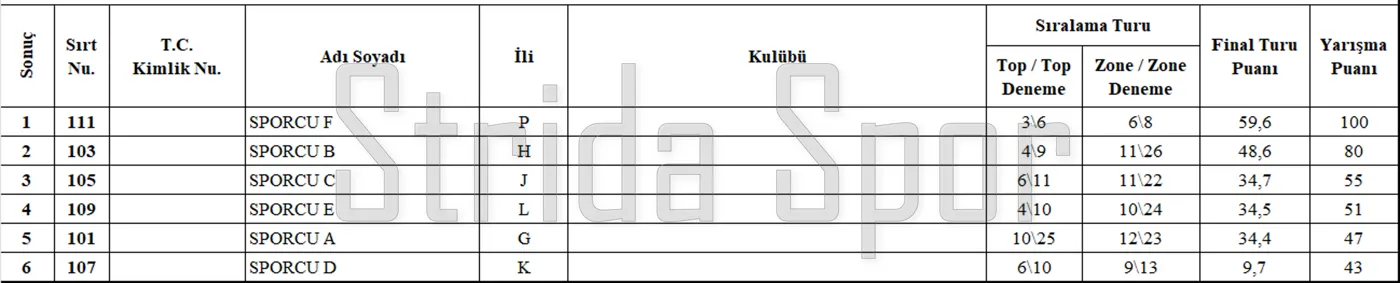
The national competition formats used in Boulder are shown in the image above. The calculation procedures in these formats are exactly the same in qualification and the other rounds, and are based on Tops/Zones and the number of attempts for Tops/Zones.
Once the results are entered, the numbers of Tops/Zones and attempts are turned into a single value with an Excel formula, as below, so that athletes can be ranked on the qualification results.
In the World Climbing format, athletes are ranked this way in all rounds (qualification, semi-final, final).
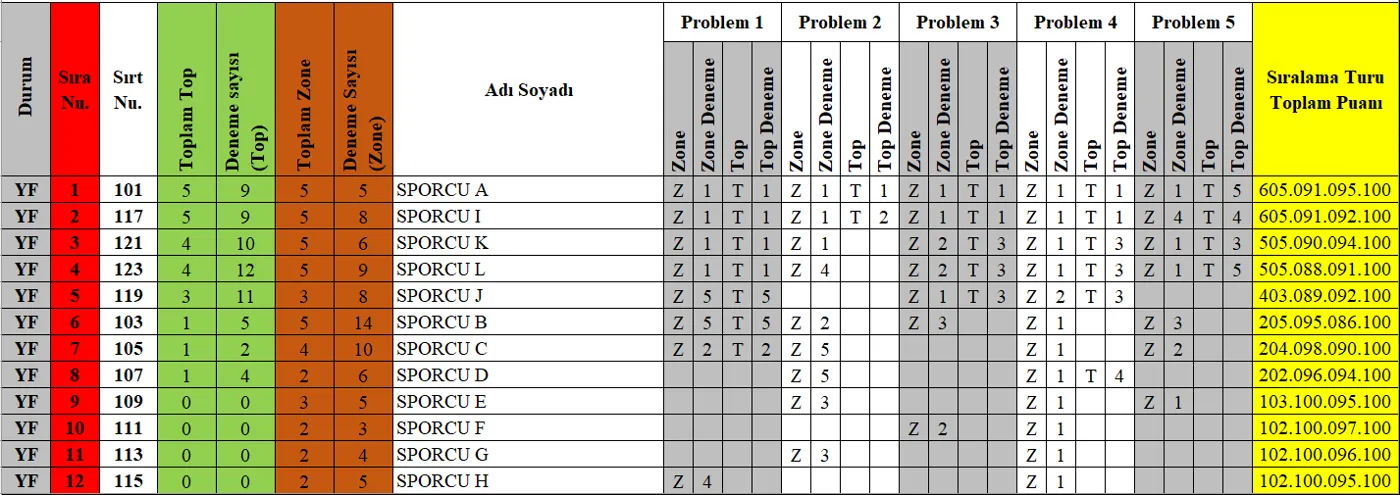
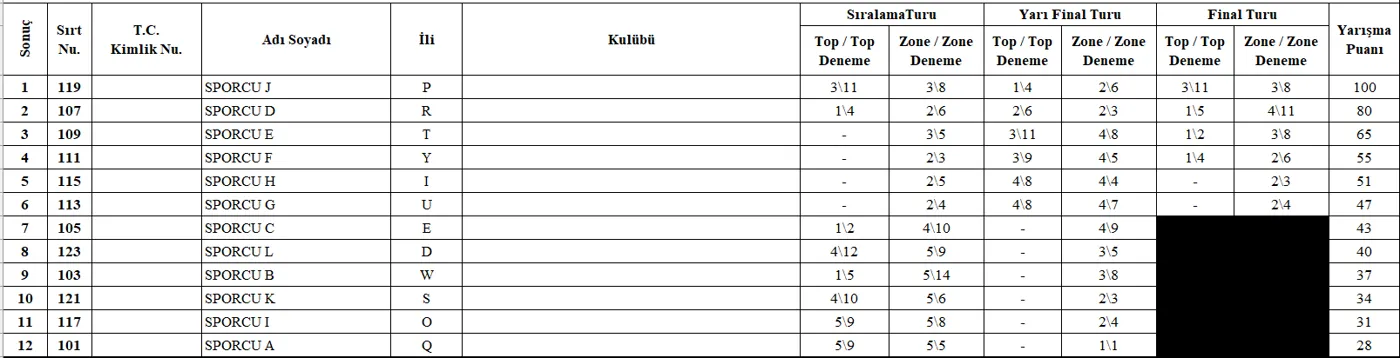
Procedure used in the multi-point format
Although the multi-point format entered the TDF national rulebook earlier, it has been in use since the 2024 competition year. Besides having more routes in qualification, its biggest advantage is that the finalists can be ranked on the final round results alone, with no need for count-back.
- The multi-point format achieves this with two zone holds on each boulder problem. In competitions held in this format, the multi-point scoring used only in the finals has two zone holds worth 5 and 10 points and one top hold worth 25 points.
- In finals held in this format, athletes have unlimited attempts.
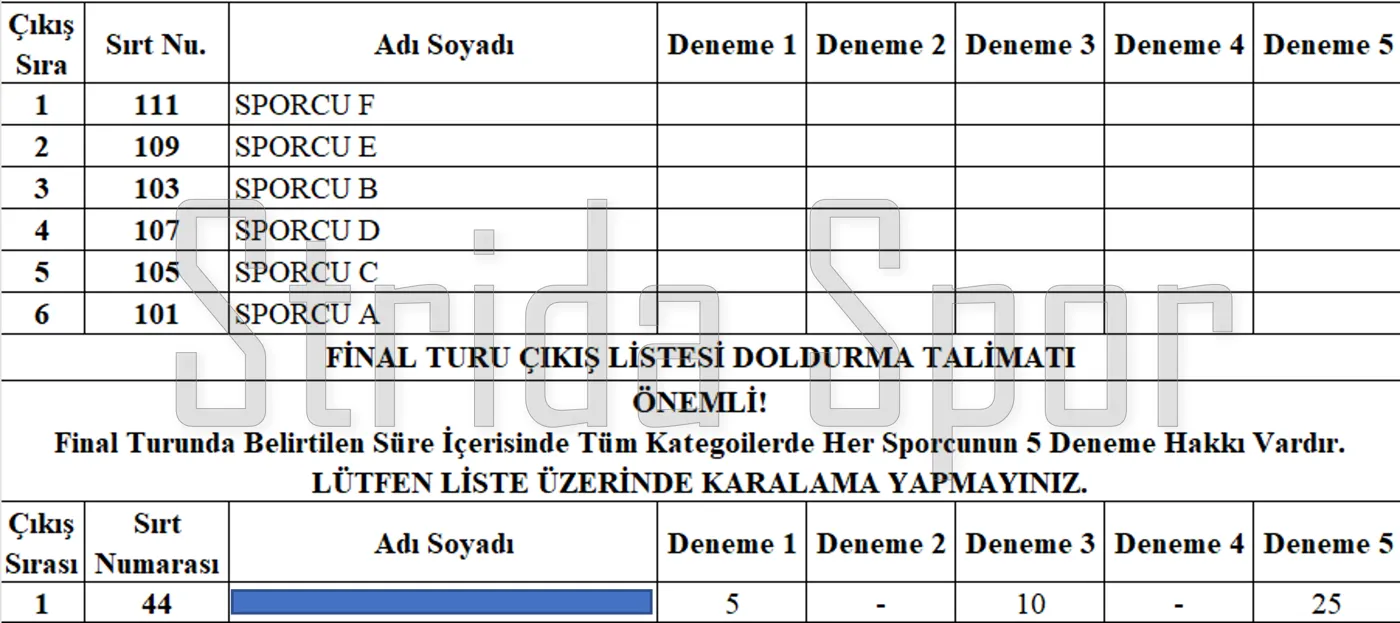
- The calculation screen of a multi-point competition is shown in the image. The aim is to find the final round total score, which separates the athletes.
- Let’s use the example to explain how the final round total score (FRTS) is calculated.
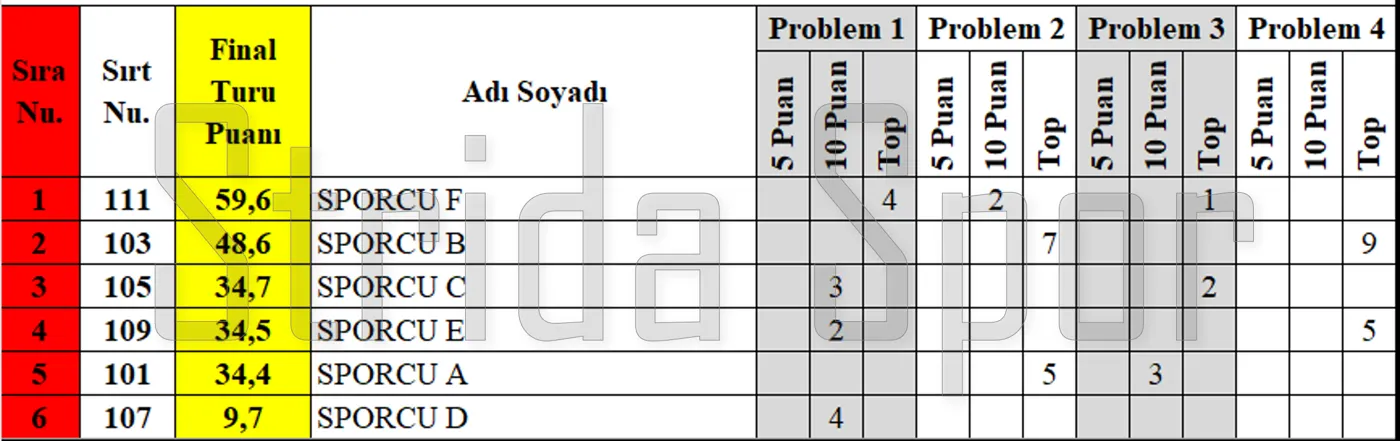
Using our example:
- For athlete D: FRTS = Route 1 score → FRTS = 10 − [(4 − 1)/10] → FRTS = 9.7.
- For athlete F:
- FRTS = Route 1 score + Route 2 score + Route 3 score →
- FRTS = [25 − [(4 − 1)/10]] + [10 − [(2 − 1)/10]] + [25 − [(1 − 1)/10]] →
- FRTS = 24.7 + 9.9 + 25 →
- FRTS = 59.6.
- The detail to note is that, when finding a problem’s score, the number of failed attempts divided by 10 is subtracted from the points scored. Looking at athlete D, we see that they scored 10 points only on problem 1, on their fourth attempt. In other words, they succeeded on the fourth attempt after failing three times, so the number of failed attempts is 3. The score is points scored − (failed attempts × 0.1) → 10 − 0.3 = 9.7.
Speed scoring
Qualification attempts and round results
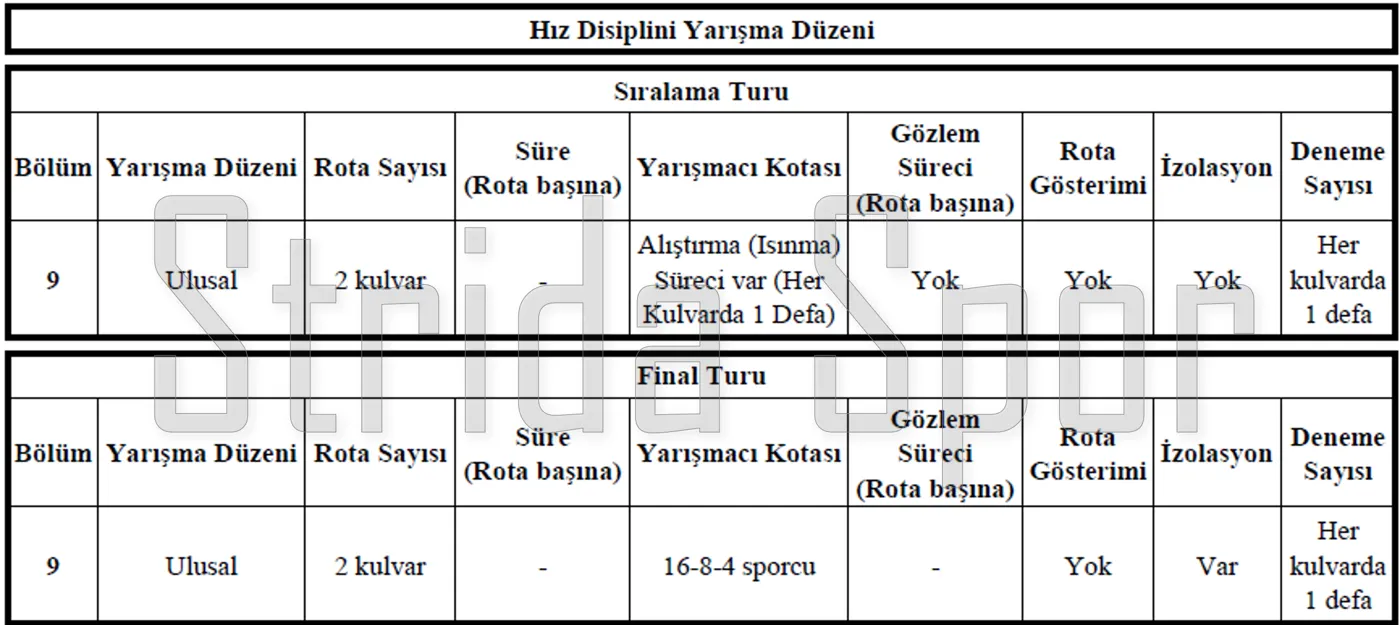
The competition format used in Speed is shown in the image above. Athletes have two attempts, one in each lane. The better of the two times is taken as the qualification result.
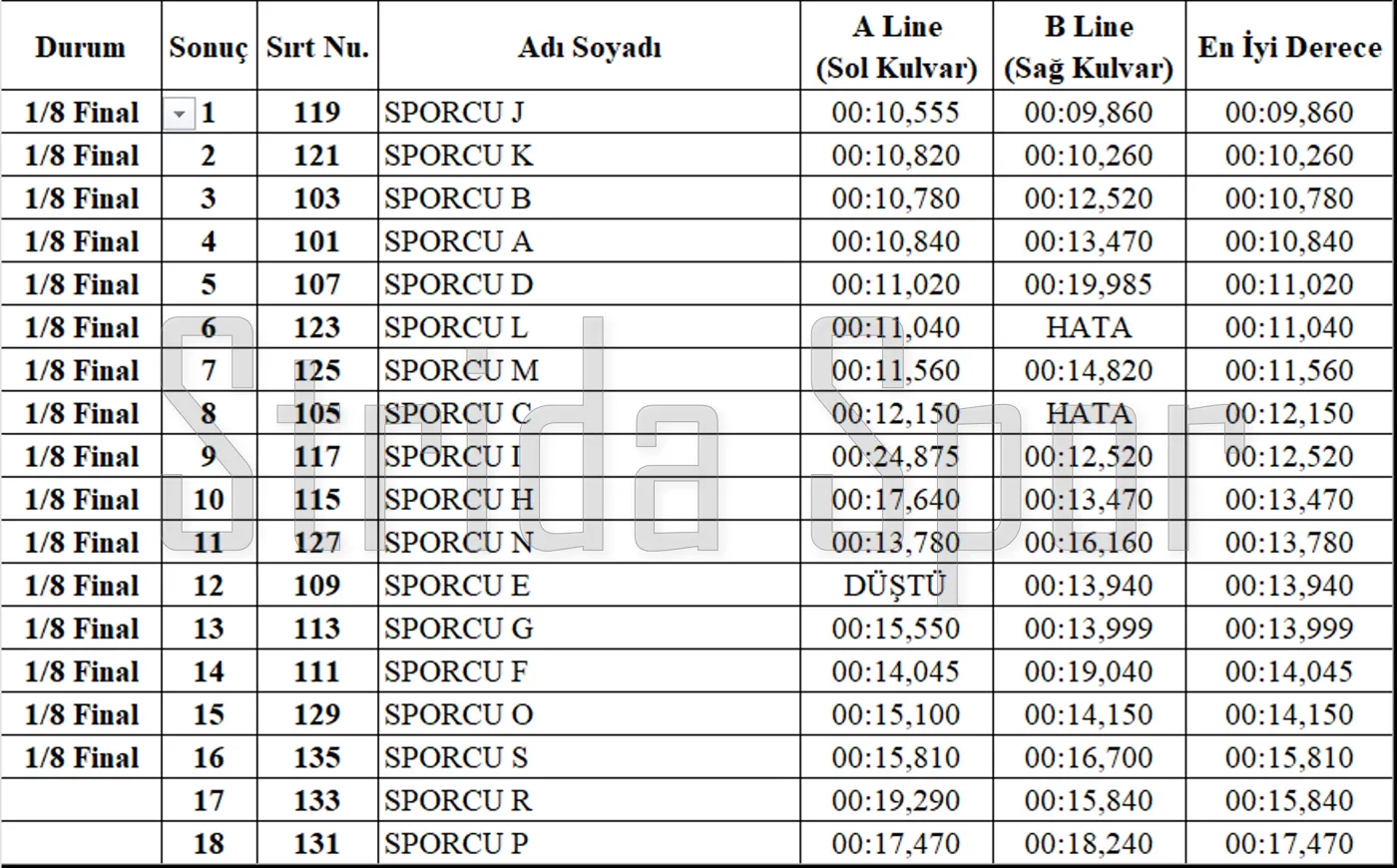
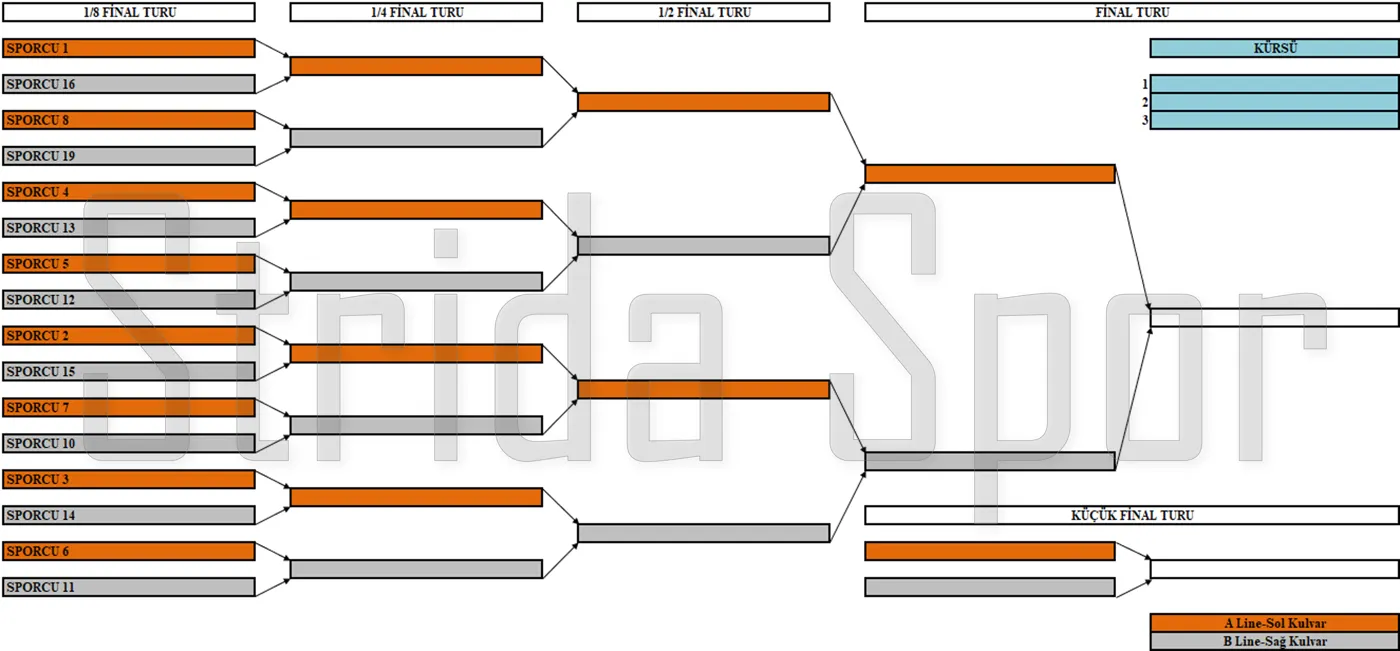
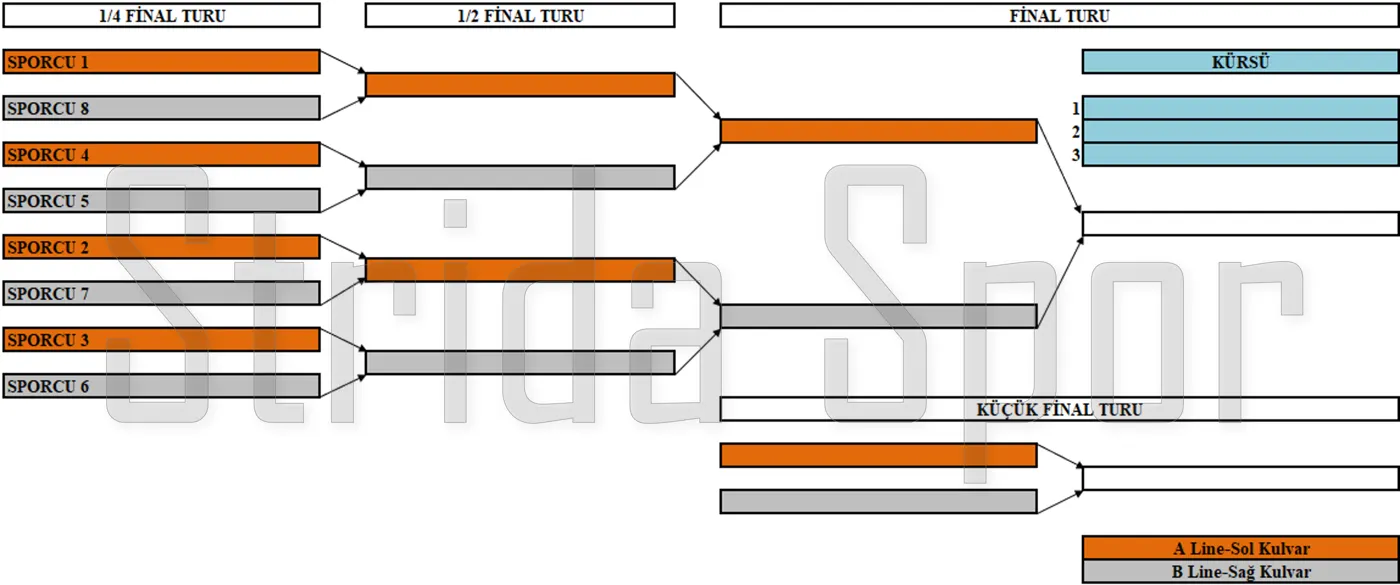
For the finals, the quota is set first. There are three starting procedures:
- Round of 16: used when at least 16 athletes have a valid time;
- Round of 8: used when 8 to 15 athletes have a valid time;
- Round of 4: used when no more than 4 athletes have a valid time.
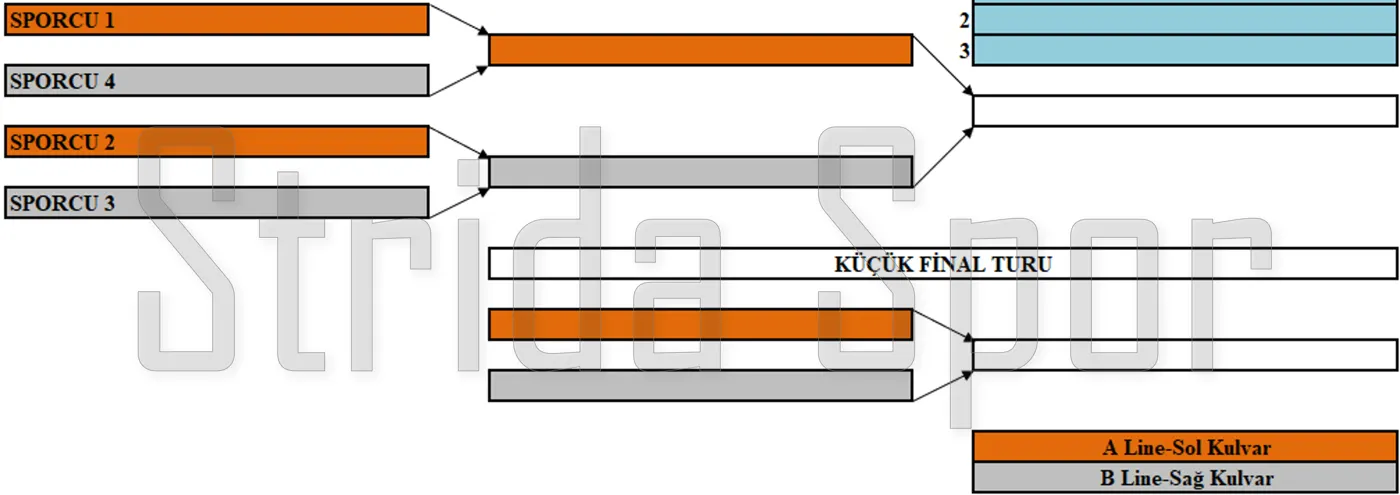
(Images of these brackets are at the end of the page.)
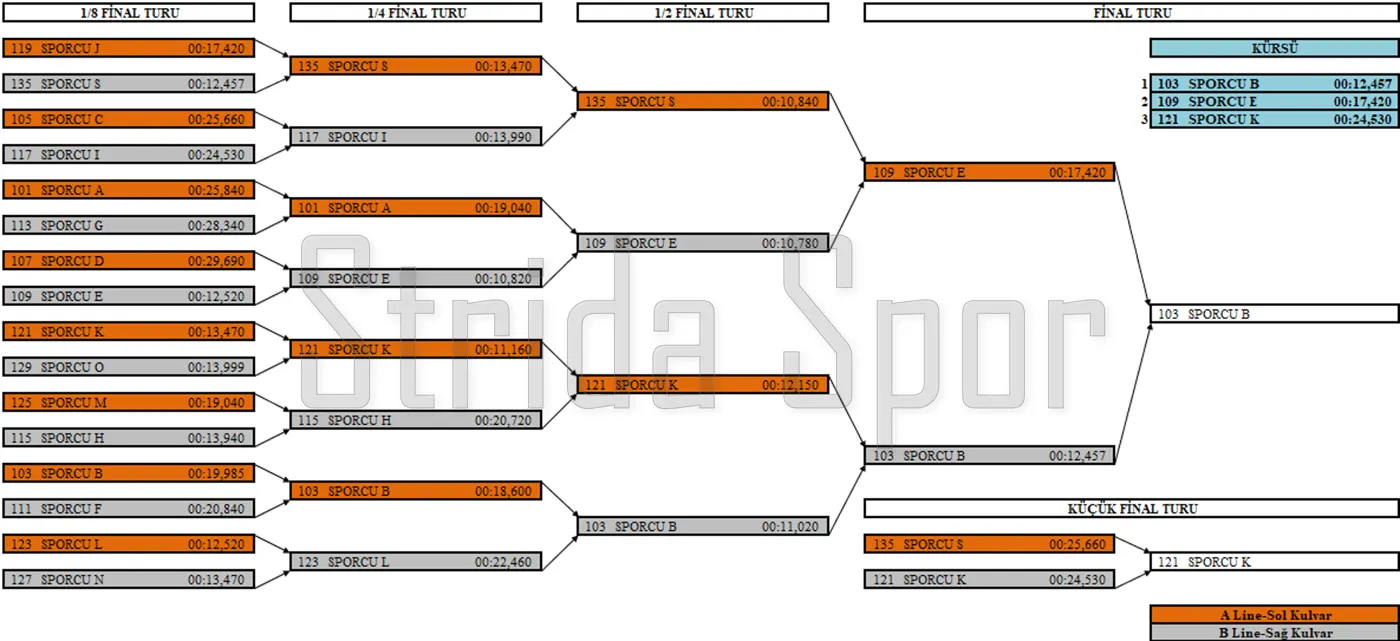
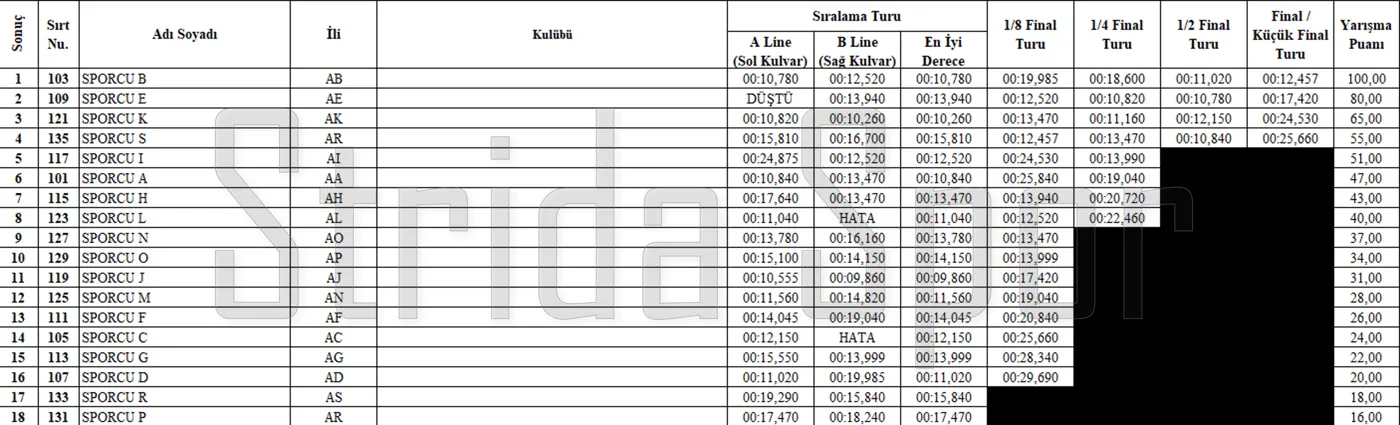
From the 2024 season, Speed results are shown live on a screen at the venue. (Above is one of the result screens shown during the finals.)
NOTE: this page explains the general scoring principles. For special cases and tie-breaking procedures, we recommend reading the TDF national rulebook via our Competition Rules page.