
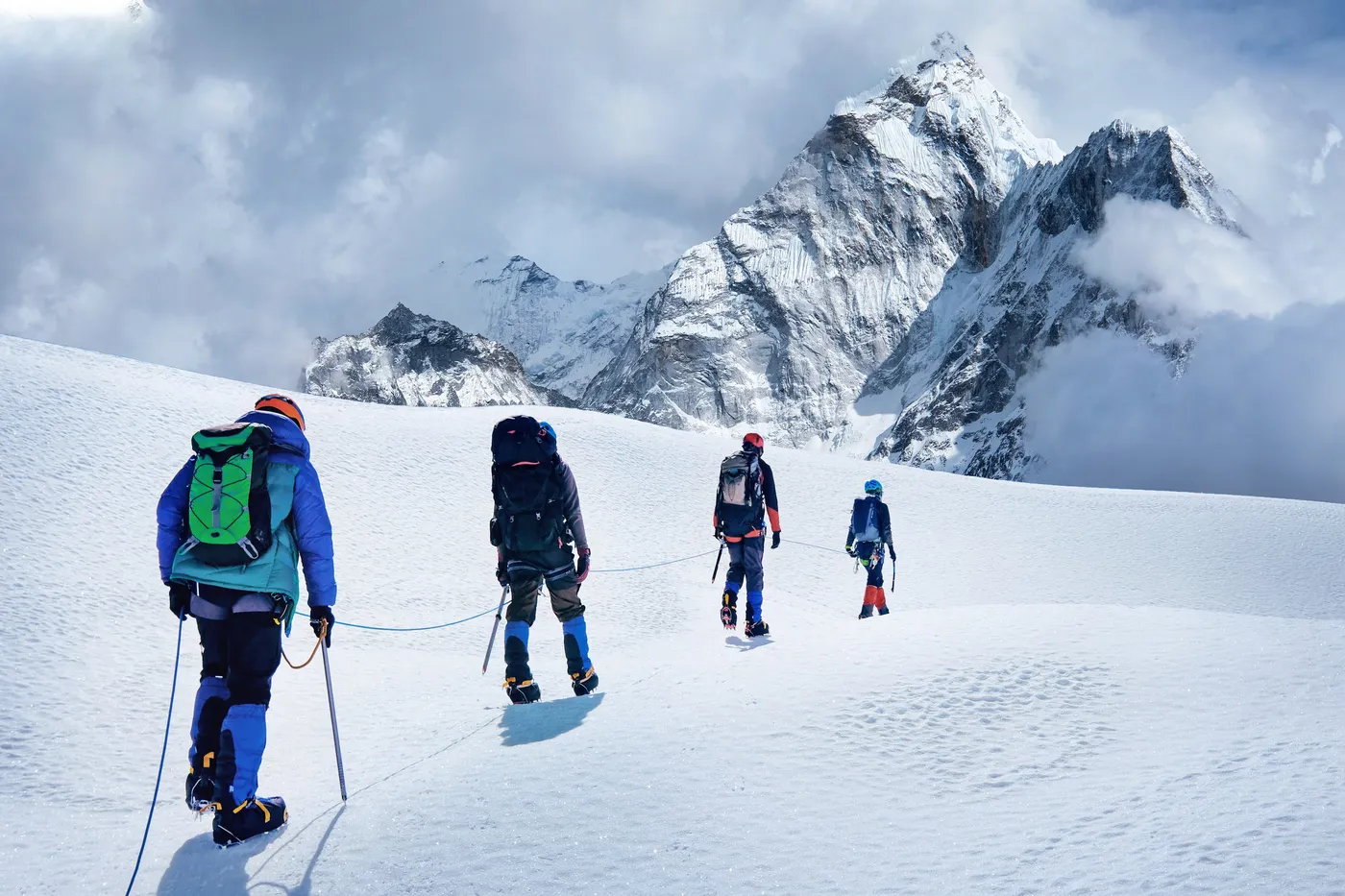
A climber heading for Everest climbs the same icefall several times and drops back to base camp before ever going for the summit. It looks like wasted effort; in fact every round trip prepares the body for the next step.
Acclimatisation is the body getting used to thinner air over days and weeks. The most important skill in high-altitude mountaineering is not handling an ice axe but giving this process time. A well-built acclimatisation plan raises your chance of reaching the summit and is the most effective protection against altitude illness. For the basics of pressure and oxygen, see What Is High Altitude?
Someone arriving from low altitude avoids sleeping above this height on the first night.
Source: WMSAbove 3,000 metres, sleeping altitude rises by no more than this per day.
Source: WMS, UIAAEvery 1,000 metres (or every 3–4 days), spend an extra night at the same altitude.
Source: WMSHow acclimatisation works
Adapting to altitude is not flipping a switch; it is more like an orchestra coming in section by section: first the breathing, then the kidneys, last of all the bone marrow.
The body adapts to altitude in layers, not in one move. Some changes begin within minutes, others take weeks:
| Time | What changes? | What you feel |
|---|---|---|
| First hours | Breathing becomes faster and deeper, heart rate rises. | Getting out of breath quickly with effort |
| First 3–5 days | The higher breathing rate settles in, the kidneys rebalance the blood’s acid–base level and the body sheds excess water. Because the fluid part of the blood shrinks, haemoglobin concentration rises. | Frequent urination, poor sleep for the first nights; in most people any headache passes |
| Weeks | The bone marrow makes more red blood cells, and slower adaptations develop in the muscles and circulation. | The same slope feels easier, sleep improves |
An important detail: altitude illness appears in the first, most fragile phase of adaptation. Once you have acclimatised to a given height, a new altitude illness at that height is not expected; if someone falls ill after several days at the same altitude, other causes should be considered too. But every new, higher sleeping point starts the process again.
There is no shortcut. Fitness, willpower and experience do not speed acclimatisation up. The body adapts at its own pace; the climber’s job is to respect it.
The golden rules
Mountaineering’s smartest rule seems to work backwards: what matters is not how high you climb today, but where you sleep tonight.
The Wilderness Medical Society (WMS) guideline, updated in 2024, and the UIAA Medical Commission agree on the same principle for acclimatisation: raise your sleeping altitude slowly. In practice:
- Do not go too high on the first night. Avoid sleeping above 2,750 metres straight from sea level or a low-lying city. If possible, spend the first 2–3 nights at around 2,500–2,750 metres.
- Above 3,000 metres, do not raise your sleeping altitude by more than 500 metres a day. The UIAA suggests a more cautious range: 300–500 metres.
- Add rest days. Every 1,000 metres or every 3–4 days, spend an extra night at the same altitude. A rest day does not mean lying in the tent; a short, easy walk helps acclimatisation.
- Climb high, sleep low. Going above your sleeping place during the day and coming back down prepares the body for the next step. Because blood oxygen drops most during sleep, the rule is built around sleeping altitude. On big expeditions this principle is applied through round trips (rotations) between base camp and the higher camps (Expedition Planning: camp layout).
- Do not go higher with symptoms. With a headache, nausea or unusual exhaustion, do not move up to sleep higher. If symptoms get worse while resting at the same height, descend.
- Take it easy for the first 48 hours. On reaching a new altitude, avoid hard efforts and alcohol for the first two days. If you are used to coffee, do not stop; the headache from caffeine withdrawal can be mistaken for an altitude headache.
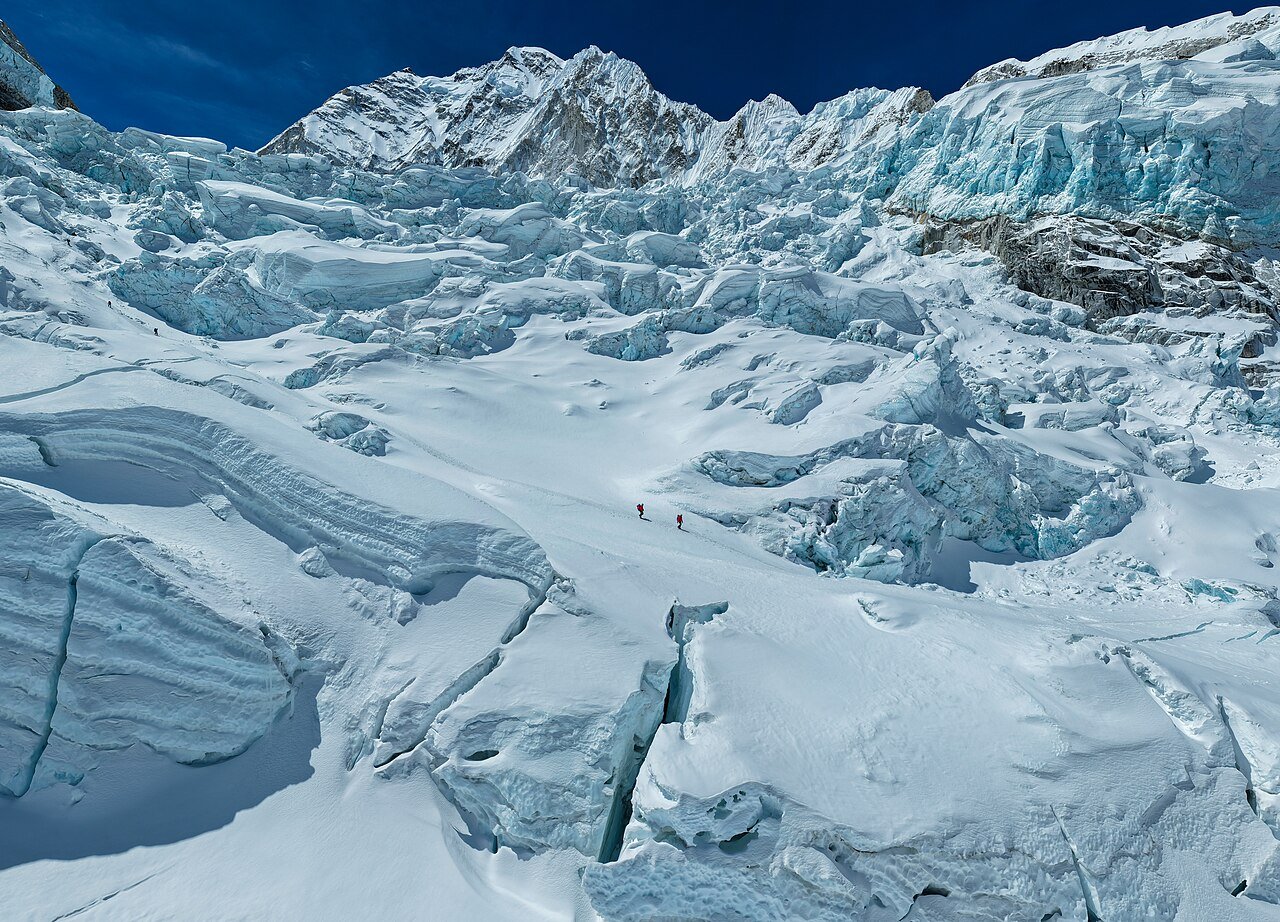
These rules are written for the average person. For some they are slow, for others still too fast. Listen to your own body and plan around the slowest-acclimatising member of the group.
A sample acclimatisation plan
How many days does it take to go from 2,800 metres to 5,500 metres? An eager beginner says “three”. A plan that follows the rules needs more than three times that.
The table below is an example made to show how the rules are applied; it is not the schedule for any particular mountain. It shows a climb starting at 2,800 metres and reaching a 5,500-metre summit.
| Day | Daytime | Sleeping altitude |
|---|---|---|
| 1 | Approach, arrive at 2,800 m | 2,800 m |
| 2 | Short walk, up to 3,200 m and back | 2,800 m |
| 3 | Move to 3,300 m | 3,300 m |
| 4 | Move to 3,800 m | 3,800 m |
| 5 | Rest; up to 4,200 m and back | 3,800 m |
| 6 | Move to 4,300 m | 4,300 m |
| 7 | Carry a load to 4,800 m, come back down | 4,300 m |
| 8 | Move to 4,800 m | 4,800 m |
| 9 | Rest and wait for weather | 4,800 m |
| 10 | Summit (5,500 m), return to 4,800 m or lower | 4,800 m or lower |
| 11 | Spare day (bad weather or slow acclimatisation) | - |
Note: summit day falls outside the sleeping-altitude rule; you go up and come back down the same day. That is why the summit should not be too far above the last camp. A spare day is not a luxury; it is part of the plan.
Acclimatisation on Mount Ağrı (Ararat)
The classic Ağrı programme climbs from 2,000 to 5,137 metres in three days. On paper it is a weekend trip; for the body it is a major test.
The classic southern route on Mount Ağrı is where the acclimatisation rules are tested most often in Türkiye. In our route recording, the walk starts at 2,022 metres, the first night is spent at 3,228 metres, the second at 4,145 metres, and summit day reaches 5,137 metres. So the first night is spent 1,200 metres above the trailhead, the next night sleeping altitude rises by another 900 metres, and summit day climbs nearly 1,000 metres. That is well beyond the rules above.
- An extra day at Camp 2: many programmes add an acclimatisation day at Camp 2, walking higher during the day and returning to camp. If your programme does not include it, consider adding it.
- Pre-acclimatisation: spending a few nights on a high mountain such as Erciyes, Süphan or Uludoruk in the weeks before Ağrı prepares the body in advance.
- Talk to a doctor: if a fast ascent cannot be avoided, preventive medication is an option to discuss with a doctor before the trip. Medication does not replace a slow ascent.
Pre-acclimatisation
Acclimatisation can start weeks earlier, not at the foot of the mountain. Often on a mountain a few hours from home.
Spending time at altitude before the trip helps. The CDC considers it useful to spend at least two nights above 2,750 metres in the two weeks before travel; the closer to the trip, the better. In Türkiye, the areas around Erciyes, Palandöken or the high plateaus of Eastern Anatolia can be used for this. We cover the training side on the Mountaineering Training page.
Hypoxic tents and masks used at home are not recommended for preventing altitude illness in the WMS 2024 guideline; studies have not shown a clear benefit.
Acclimatisation does not last
Someone who slept comfortably at 5,000 metres last summer can wake up with a pounding head in the same tent this summer. The body learns thin air, but it forgets it quickly too.
Acclimatisation fades over time at lower altitude. Descending for a few days’ rest during an expedition helps recovery, but someone returning to the same height after a long break may have to rebuild acclimatisation from scratch. Acclimatised climbers are also at risk when moving to a higher camp, especially if sleeping altitude suddenly rises by 600–900 metres.
Final word: the acclimatisation plan should be the most flexible plan on the mountain. If someone cannot adapt, the group waits, or that person descends with a safe partner. The summit will still be there next time.
Sources
6
- Sleeping-altitude and rest-day rules – Luks et al.: Wilderness Medical Society Clinical Practice Guidelines for Acute Altitude Illness, 2024 Update
- Stages of acclimatisation, the first 48 hours and pre-acclimatisation – CDC Yellow Book: High-Altitude Travel and Altitude Illness
- UIAA ascent rule – UIAA Medical Commission: 4 x 4 Health Rules for Mountaineers (2008)
- Hypoxic tents – Omidi et al.: What Is New in Altitude- and Cold-Related Illnesses of Travel (summary of the WMS 2024 guidelines, 2025)
- Mount Ağrı camp altitudes – Stridaspor Mount Ağrı route recording (Our Mountains)
- EPAS1 and Denisovan ancestry in Tibetans – Huerta-Sánchez et al.: Altitude adaptation in Tibetans caused by introgression of Denisovan-like DNA, Nature (2014)