
At some point the path ends. Ahead of you is a rock ridge falling away on both sides, with steps you cannot pass without using your hands. This is no longer walking, but not yet climbing either: the most loved and most underestimated terrain in mountaineering.
Rocky ridges, couloirs and short rock steps are part of many mountain routes. In the Aladağlar, the Kaçkar or Cilo-Sat, the way to a summit often passes through this kind of terrain. This page starts from rocky ground where you use your hands and moves on to ridge and couloir crossings, the basics of alpine rock climbing as a rope team, and the via ferrata, where you move along steel cables fixed to the rock.
This page does not replace training. Moving on rock, using a rope and the via ferrata set are learned with an instructor in a place where a fall is harmless (Clubs, Courses and Training Levels). Knots, belaying and abseiling are on Rope Techniques and Abseiling, and route grades on Routes and Grades.
The route Friedrich Simony equipped with iron pegs, handholds and ropes on the Dachstein (Austria); considered the forerunner of today’s via ferratas.
Source: Via ferrata, WikipediaThe number of via ferratas in the European Alps. Most are in Italy and Austria.
Source: Via ferrata, WikipediaThe user weight range for which EN 958:2017 via ferrata sets can be used safely (upper limit including equipment).
Source: EN 958:2017, Climbing TechnologyFrom walking to climbing: rocky terrain
The moment you put your hands on rock for the first time, the route changes for you: now a wrong step can be a fall.

Rocky ground where you use your hands but do not yet need a rope is called scrambling. The British Mountaineering Council (BMC) groups such routes in Britain into three grades: grade 1 is mostly an exposed, high walk, where the hard parts can often be avoided; grade 2 may need a rope in places; and grade 3 is expected to need a rope on several sections, approaching the easiest rock climbing grades. In the Alps the same terrain is described with the T4–T6 hiking grades or alpine grades such as F and PD (Routes and Grades).
- Three points of contact: while one hand or foot moves, the other three stay on the rock. Keep your weight on your feet; the hands give balance.
- Test the rock: before putting weight on a hold, feel it or tap it lightly. Do not use a block that moves, sounds hollow or is cracked; load holds downwards, pressing into the rock, not pulling outwards.
- Think about the way down: descending a step you have climbed is often harder. You may have to turn back; think about the way back before committing to somewhere you cannot pass.
- Wet rock: in rain, frost and verglas the same step becomes a completely different difficulty. In the rain, the BMC advises avoiding vegetated, face-like routes and choosing ridges, where water drains faster.
- Helmet: wear a helmet if there is another team above, if you are on terrain that may need a rope, or if stones may fall.
Ridge traverses
A ridge gives you the mountain’s best view: a different valley on each side. The same view tells you that you can fall either way.
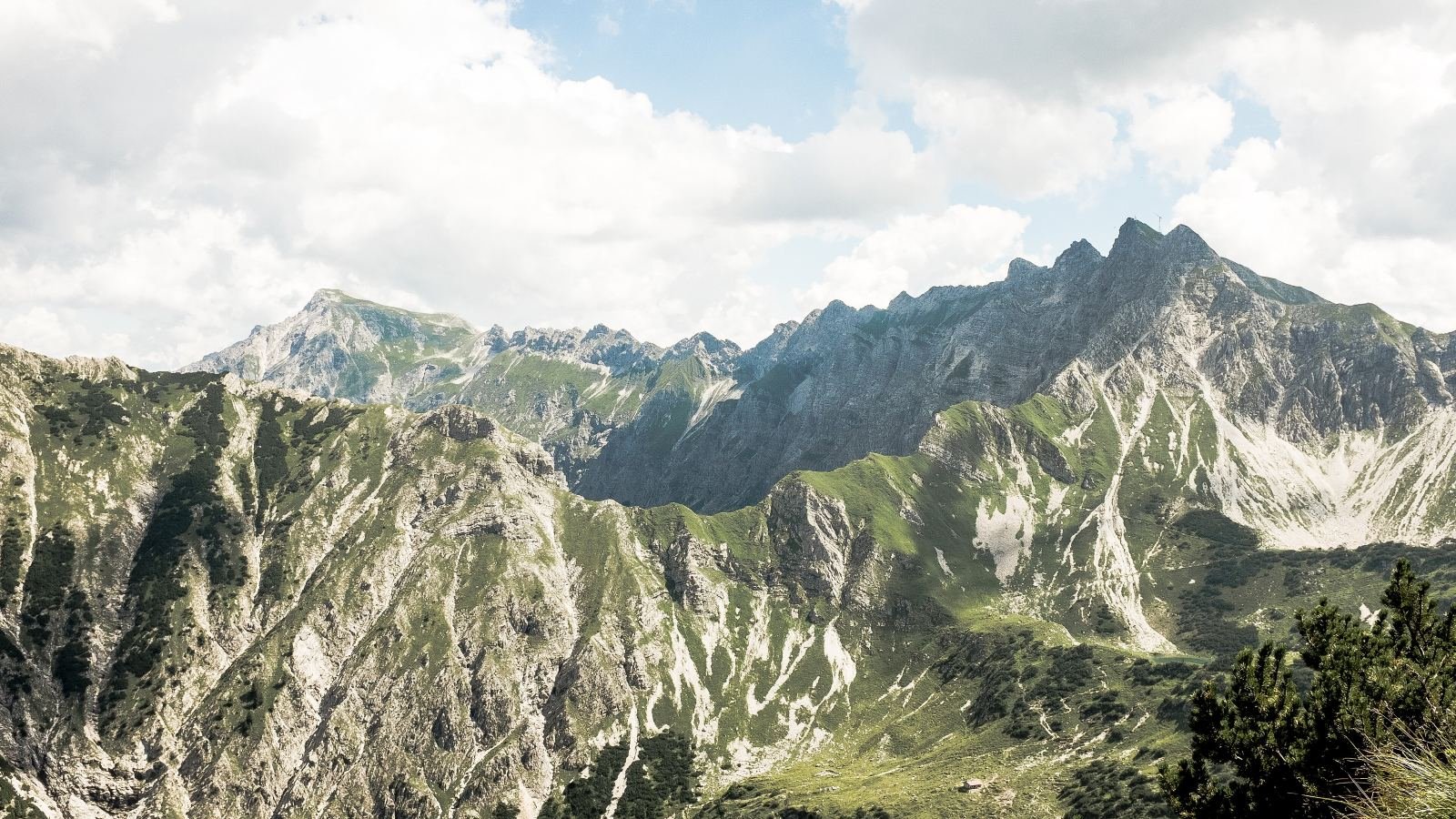
Rocky ridges are often the most natural way to a summit: navigation is easy, there is less rockfall than on faces, and they dry quickly after rain. But exposure, wind and weather changes are felt most on a ridge.
- Follow the ridge’s soundest line, not the edge: the very crest is sometimes the hardest part; a path a few metres to the side can be easier. But tracks that lead away from the ridge often drop into loose slopes and onto cliffs.
- Escape points: before setting off, work out from the map and route description where you can descend from a long ridge into the valley. If the weather turns, use the nearest escape route.
- Storms: a ridge is one of the places most exposed to lightning. Start early to beat afternoon storms, and come off the ridge when clouds start to build (How to Read Mountain Weather).
- Snowy ridges: in winter and spring there may be cornices on the ridge; never step on a cornice (Snow and Ice Techniques).
Couloir crossings
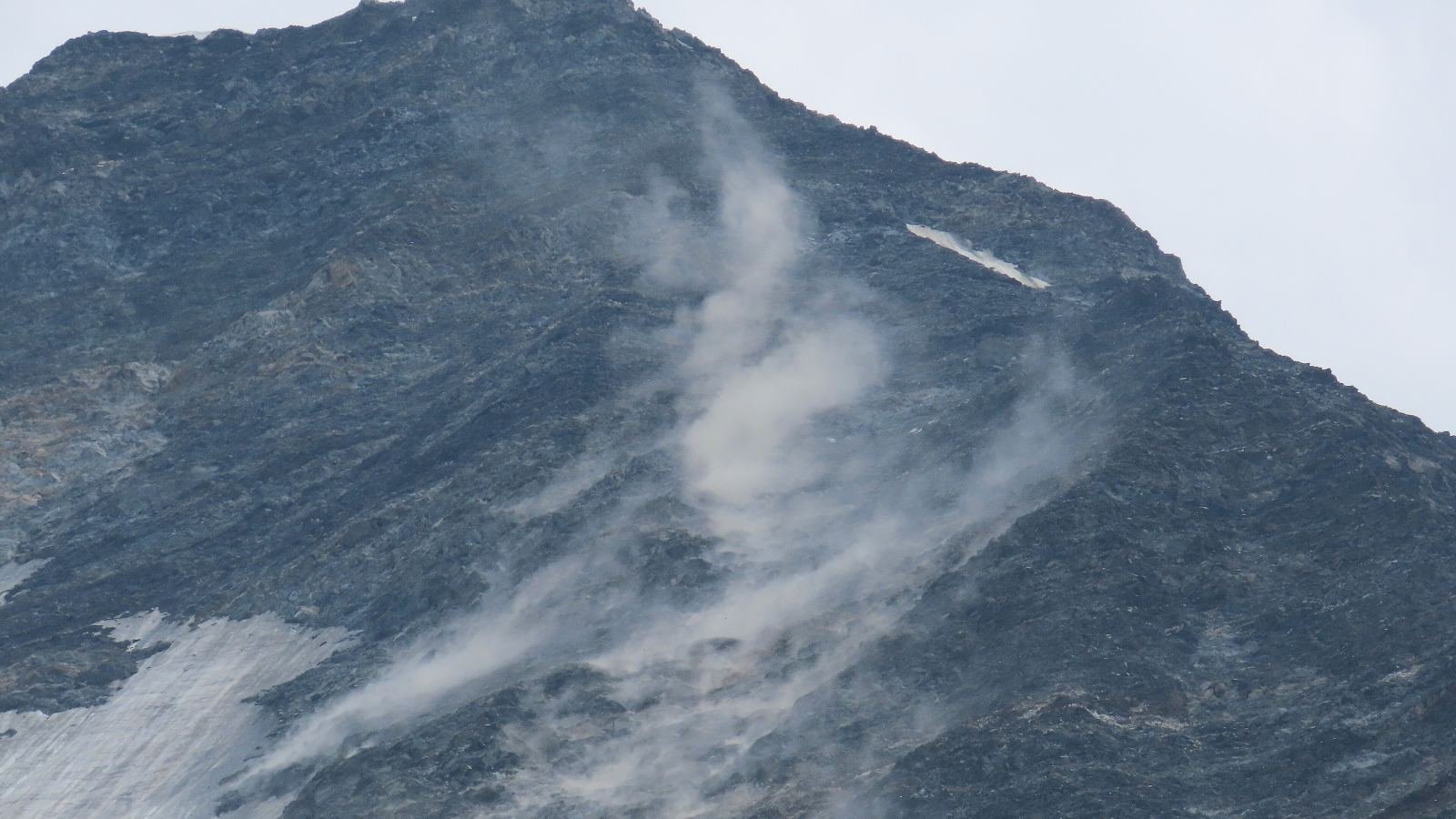
A couloir is the mountain’s gutter: everything that falls from above, stones, ice or avalanches, sooner or later passes through it. And so do you.
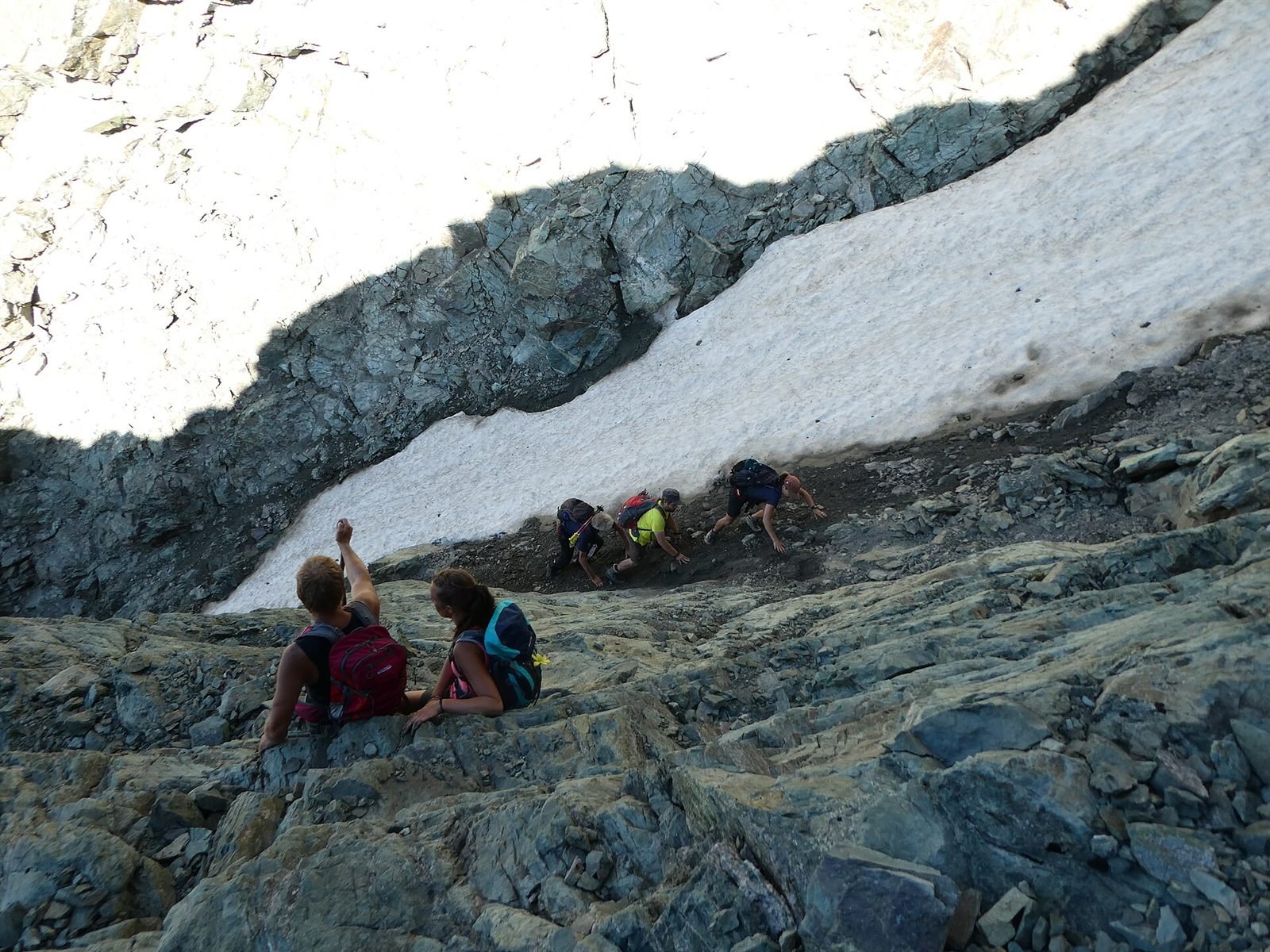
A couloir is a narrow, steep valley or gully in a mountain face. In summer it may be full of stones and scree, in winter and spring of snow. When full of snow, couloirs are often the easiest way to a summit; but the couloir itself is a channel where everything from above collects.
- Early hours: snow and ice frozen overnight hold stones in place. When the sun hits the slope and the ice starts to thaw, rockfall increases. Cross couloirs in the cold, early in the morning, and be out before the sun hits them.
- Helmet and attention: the helmet is always on. Shout “Rock!” loudly for every stone that falls or is knocked down; anyone hearing it does not look up but presses against the rock or snow and protects their head.
- Do not stop in the middle of the couloir: take breaks at the side of the couloir, sheltered by a rock outcrop. The team moves not directly above one another but either out of the line of each other’s stones or very close together.
- Snowy couloirs: a snowy couloir is also an avalanche path. Snow conditions and avalanche danger are on Avalanches and Snow, and moving with crampons and ice axe on Snow and Ice Techniques. Rockfall is also covered on Mountain Hazards.
Couloirs are avalanche paths in summer too: new snow, wet snow and breaking cornices come down the couloirs first. Enter a couloir early in the morning while the snow is frozen; do not be in a couloir in the afternoon when the snow is wet (Avalanches happen in summer too).
Basics of alpine rock climbing
In sport climbing, the hardest move wins. In the mountains, it is usually the fastest and safest decision.
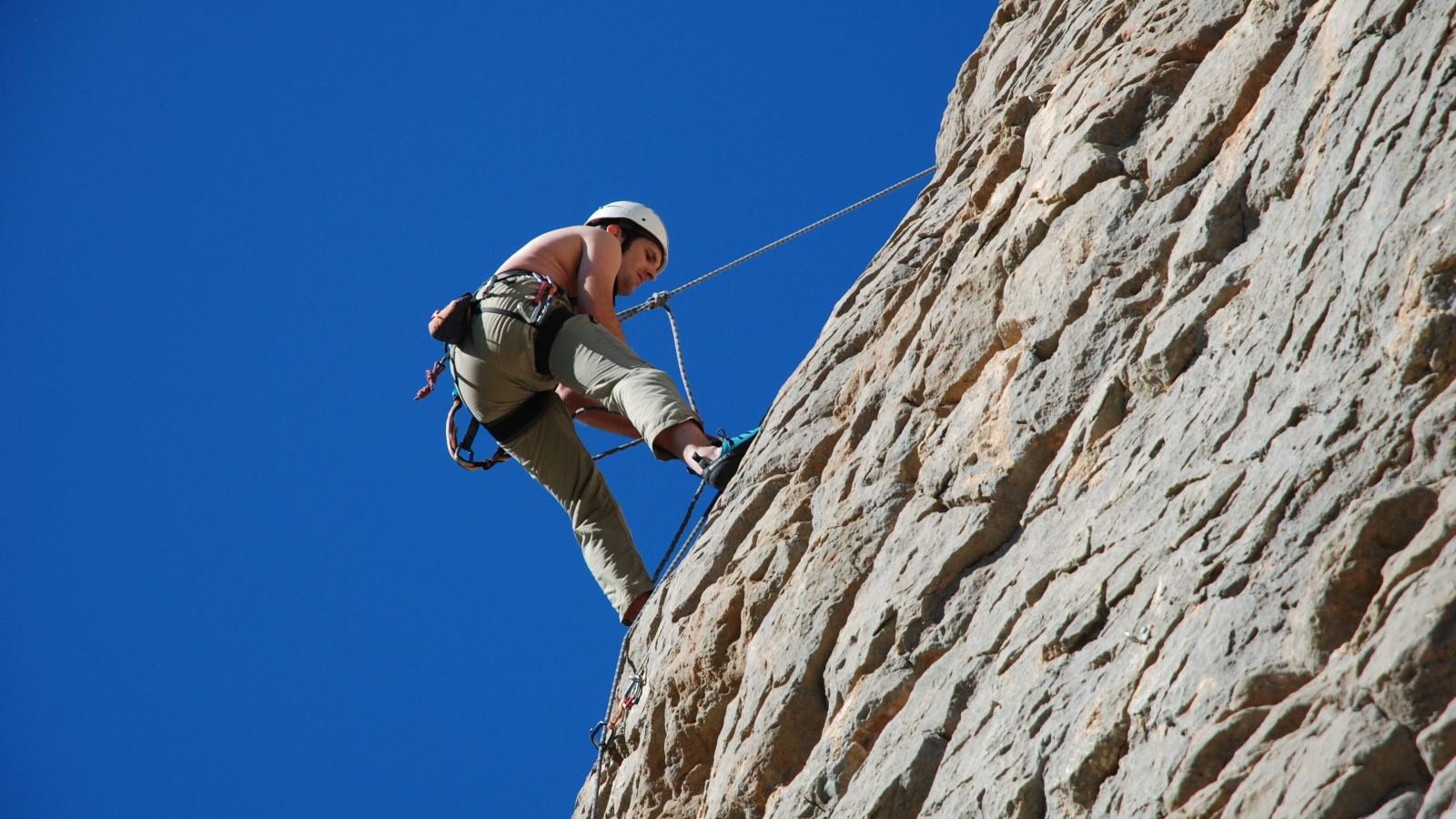
Alpine rock climbing is climbing the rock sections of a mountain route as a rope team. Rock grades are usually lower than in sport climbing; the real difficulty is the length of the route, loose rock, weather, altitude and the difficulty of retreat. The methods the BMC suggests for rocky terrain, from fastest to safest, are:
| Method | How | When |
|---|---|---|
| Unroped (solo) | Everyone moves on their own | Only on easy terrain and for confident, experienced climbers |
| Moving together (short-roping) | Part of the rope is shortened in coils over the shoulder; two people move at the same time, the leader running the rope through intermediate protection | On easy sections where a fall would be dangerous; both people must master the technique |
| Pitched climbing | One climbs while the other belays from a solid belay; they swap at the end of each pitch | On hard, wet or windy sections, or where a fall would be serious; the slowest but safest method |
- The leader must not fall: a fall on rocky terrain is far more serious than a fall on a sport route at a wall or crag: you hit ledges, and protection is sparse. The leader should move on terrain well below their grade.
- The traps of moving together: The Mountaineers’ warning is clear: done well, moving together saves time; done badly, it raises the risk for every member of the rope team. The person behind can knock stones down the rope or pull the leader off with a fall. The short-roping used by guides relies on a trained guide’s attention; it is not suitable for an inexperienced team.
- Equipment: for grade 2 and 3 scrambling, the BMC recommends a helmet, harness, a thin 50–60 m single rope, a few long slings and an HMS carabiner, a small rack of nuts and a belay device. To retreat from rock routes, you must know how to abseil and have practised it beforehand.
- Speed is safety too: on a long route, extra minutes spent on each pitch mean being caught by darkness and afternoon storms. Being fast does not mean rushing; it means doing things in order, without having to redo them.
Via ferrata
Iron rungs driven into a rock wall, a ladder hanging in the air, a steel cable running from start to finish. The via ferrata opens the vertical world to non-climbers too; but the price is attention.
Via ferrata means “iron way” in Italian: a climbing route equipped with steel cable, iron rungs, ladders and bridges fixed to the rock. The climber clips to the cable with a via ferrata set attached to their harness and moves along it. Grading scales (Schall A–F, Hüsler K1–K6) are on the Routes and Grades page.

The via ferrata set
The set consists of a two-armed (Y-shaped) lanyard with an energy absorber and two large carabiners at the ends of the arms. The Austrian Alpine Club’s training series sums it up like this: the set does not prevent a fall, but it prevents a free fall. Falls on a via ferrata are hard and dangerous; you fall to the next anchor and can hit rungs and rock.

- Only standard sets: in Europe, sets conform to the EN 958 standard. The standard was revised in 2017 after a fatal accident in 2012 in which both elastic arms broke. Do not use old, home-made or recalled sets; discard a set whose energy absorber has been activated once.
- Weight range: EN 958:2017 sets are designed for users weighing at least 40 kg without equipment and at most 120 kg with equipment. For light children and anyone outside this range, the energy absorber may not work correctly; in that case an additional rope belay is needed.
- The rest: harness, helmet, gloves and shoes with good grip. The Austrian Alpine Club lists these as the five items to carry every time.
Moving on a via ferrata
- Partner check: before starting, two people check each other’s harness, the set’s attachment to the harness and helmet, by eye and by hand.
- Changing clips at an anchor: at an anchor on the cable, in a stable, balanced position, the carabiners are moved one at a time to the next section. At least one carabiner is on the cable at all times; never open both at once.
- One person per section: only one person is on the cable between two anchors at a time; on steep, hard sections, leave an empty section in between. If someone falls, they do not hit the person below.
- Straight arms, legs do the work: the arms are mainly there to stop you falling backwards. Place your feet carefully and keep your weight over them. Rest before hard sections; take short breaks by clipping a rest sling to the cable.
- Lightning: steel cables and ladders are a giant lightning rod. Watch the forecast and the clouds; leave the via ferrata as a storm approaches.
- Fitness and retreat: alpine via ferratas demand fitness and endurance. Fatigue is a main cause of accidents; know the route’s escape points in advance.
Via ferrata in Türkiye
The via ferrata is still very new in Türkiye. According to news reports, the route installed in 2017 on the rock wall of Eğin Gabanı near the Karanlık Canyon in the Kemaliye district of Erzincan consists of 517 iron rungs. The president of KEMAV, which built it, says it is Türkiye’s first via ferrata and that it was first built so that wingsuit jumpers could reach the top. Before going to a route, find out from local clubs and managers who maintains it and whether it is open.
Where are these techniques learned?
There is no short cut to moving comfortably on rock: the hours spent on low rocks are the confidence gained on high ridges.
Moving on rocky terrain begins on the Turkish Mountaineering Federation’s summer mountaineering course; belaying and abseiling are taught on the single-pitch rock climbing course, building belays on the multi-pitch course, and mountain routes where rock is combined with snow and ice on the alpine climbing course. The best way to improve your rock technique is to climb on a rope at crags and climbing walls (Climbing). Training levels and finding a club are on the Clubs, Courses and Training Levels page.
Sources
11
- Scrambling grades (1–3) – BMC: Scrambling skills, the grades explained
- Rope, equipment, wet rock, helmets and retreat on scrambles – BMC: How to stay safe on scrambles
- Pros and cons of moving together – The Mountaineers: Simul-Climbing, Pros and Cons
- Short-roping and safety on easy rocky terrain – American Alpine Club: Know the Ropes, Safer 4th Class
- Via ferrata: the name, Simony (1843), the First World War, numbers in the Alps, the Y set and the revision of EN 958 – Wikipedia: Via ferrata
- EN 958:2017 weight range (40–120 kg) – Climbing Technology: via ferrata set user manual
- Via ferrata equipment, lightning and tour planning – Climbers Paradise / Austrian Alpine Club: Via ferrata, everything you need to know
- Moving on a via ferrata, changing clips, spacing and partner checks – Climbers Paradise: Via ferrata tutorial 04
- The Kemaliye via ferrata (517 rungs) – DHA, 3 July 2022 (in Turkish)
- The building of the Kemaliye via ferrata and the “first in Türkiye” statement – NTV: 41st Kemaliye Culture and Nature Sports Festival (in Turkish)
- Mountaineering courses in Türkiye – Turkish Mountaineering Federation